API updates · Reporting
OpenAI updates its Model Spec: what API teams should review
The October 29 Model Spec revision reorganizes intended behavior around five values. Here is what changed, what remains uncertain, and a practical developer review.
The announcement: a revised behavior specification
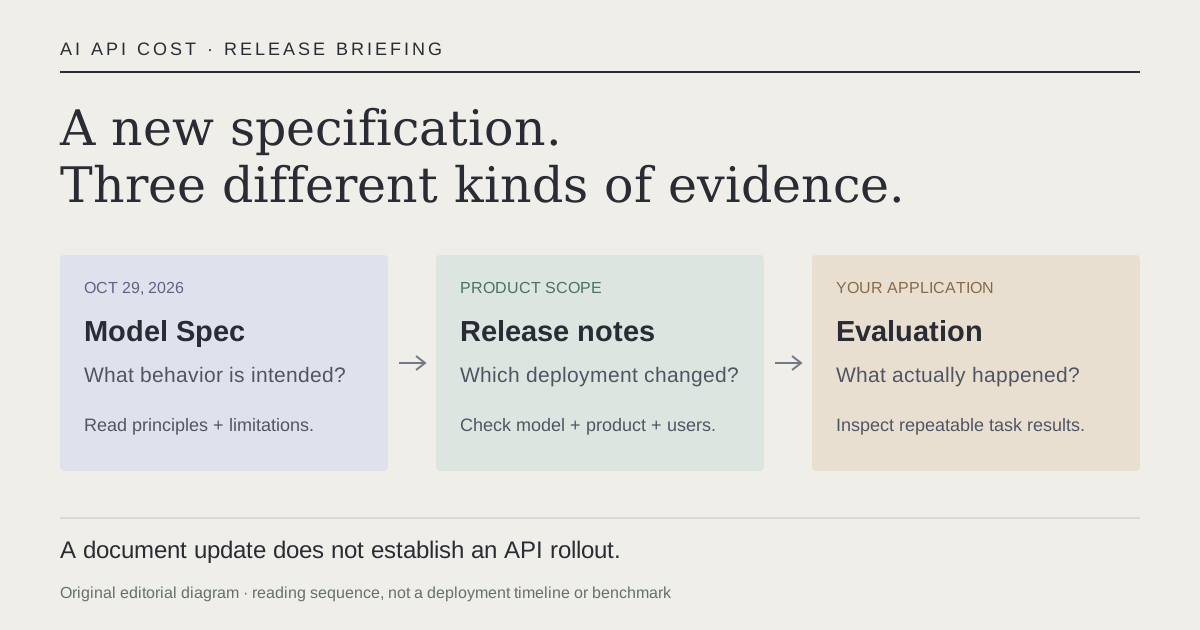
Two OpenAI entries dated October 29 describe different kinds of change: a revision to the Model Spec and a product-specific GPT-6 Chat update. For an API team, the useful first question is which one applies to the application being shipped. The specification describes intended behavior; a release entry identifies a deployment and its audience. Reading the two as interchangeable can produce the wrong test plan.
The revised Model Spec organizes intended behavior around faithfulness to human intent, minimizing harm, honesty and transparency, human agency, and care. OpenAI also describes changes concerning context, oversight and side effects, plus the retirement of most detailed style guidance. Its announcement says the models do not yet fully reflect the specification. That limitation makes application-level testing the next step, rather than treating the new document as evidence that every endpoint has changed.
Read the update in three passes
- 1Specification
Read the stated behavioral goal and its limitations.
- 2Release scope
Identify the model, product, access group and deployment date named by the provider.
- 3Application evidence
Run your own representative cases before changing production assumptions.
Read the release notes beside the policy news
The official Model Release Notes list the October 29 specification change separately from a GPT-6 Chat update on the same date. That Chat entry describes more concise responses and less flattering language for particular user groups; it also explains the limited applicability to Plus and Pro fallback behavior. A shared announcement date is not evidence that a Chat change applies to every API request.
This distinction suggests a useful reading habit: identify whether a provider announcement concerns a behavioral goal, a deployed model version, a product-specific rollout or a billing change before changing an application. Write that classification beside the source link. If the announcement does not identify your API deployment, keep the deployment effect unknown and use direct testing for your own endpoint.
Two October 29 entries, two different scopes
Scroll sideways to read all columns.
| Entry | What the provider says | What an API team can conclude |
|---|---|---|
| Model Spec revision | Five values; revised context, oversight and side-effect guidance; most detailed style guidance retired | The published behavioral target changed; full model compliance is not claimed |
| GPT-6 Chat update | More concise replies and less flattering language for specified Chat groups | Check product and user scope; it does not establish a universal API change |
A small review an application team can run
Start with three kinds of existing evaluation case: unclear intent, conflicting instructions, and an action affecting another system. An ambiguous request to edit a customer record is more revealing than an abstract question about helpfulness. Record the exact prompt, model identifier, date and expected outcome. Inspect whether the application exposes its assumptions, resolves missing information, and keeps the proposed edit within the user's request. This is a suggested test plan, rather than a benchmark result.
Include ordinary successful tasks as well as difficult ones. A model that handles an ambiguous case carefully can still frustrate users if straightforward work stops unnecessarily. For an application that sends messages or changes records, separate the quality of its proposed action from the execution of that action. You can examine a preview without sending a real customer message or modifying a live record simply to test behavior.
Keep historical context and deployment evidence distinct
OpenAI's original May 2024 introduction described the Model Spec as a document about desired behavior in the API and ChatGPT and said it would evolve. That history helps explain why a revision deserves reading without turning it into a claim about a new endpoint or price. The latest announcement and release notes are the sources for the October 2026 change; the earlier introduction supplies background only.
Keep one record joining the provider entry to your test results: source date, deployed model, task, observed behavior, and release decision. If a response becomes shorter, check whether it still contains the fields your application needs. If the system asks for confirmation more often, distinguish cases where information is genuinely missing from routine work it could complete. Keep successful and failed examples together. That record gives the next developer something more useful than a general claim that the model became better or worse.
Sources & verification
Provider documentation supports the facts referenced below. Our explanations and recommendations are editorial interpretation.
- OpenAI: An updated Model Spec for more capable and beneficial AI ↗Checked Oct 31, 2026
- OpenAI Model Release Notes ↗Checked Oct 31, 2026
- OpenAI: Introducing the Model Spec ↗Checked Oct 31, 2026
Corrections: hello@aiapicost.com