Developer workflow · Practical guide
Before switching AI APIs, test the grader with a wrong answer
A new Hugging Face evaluation guide shows how a plausible shortcut can fool a weak check. Use control outputs before trusting your cost per completed task.
Check what the score actually accepts
Hugging Face's November 23 guide to agentic evaluations includes a useful warning for API buyers. Its authors tried a shortcut that calculated a plausible spectrum ratio without doing the required curve fitting. A ratio-only grader would have accepted it across eight synthetic tasks; they added fit checks to reject it. That is a flaw in the measurement, not evidence that a cheaper model completed the same work.
The accompanying raman-lab dataset exposes task instructions, environments, reference solutions and verifier files. Those components let a reviewer ask what a pass means rather than relying on a leaderboard number. The example is a development set, not a universal ranking of production APIs.
A verifier is executable scoring logic. Harbor's documentation, for example, gives tests/test.sh responsibility for checking completion and writing a numerical reward. That reward encodes the script's assertions; it does not independently establish that those assertions cover the user's requirements.
Try controls before paying for more model attempts
For a small example, imagine an agent cleaning a CSV export. Specify the required records, unique identifiers and amount transformations before writing the checker. Decide whether row order matters. A file-exists test cannot establish any of those properties, and a parseable CSV can contain nothing but a header.
The table proposes four control outputs to submit directly to the grader, without calling a model. A known-good artifact should pass. An empty artifact and a valid-looking result containing the previous input's different record IDs should fail. A correct result with reordered rows should pass when order is outside the contract. If a verdict surprises you, inspect the task wording and checker together.
Use a clean starting state for each later agent trial so a previous output cannot supply a false success. Anthropic's evaluation guidance identifies leftover files and shared state as sources of misleading results, and recommends assessing the produced outcome without demanding one arbitrary sequence of tool calls. Keep genuinely required actions explicit; do not penalize a valid shortcut merely because it differs from your reference implementation.
Control outputs for a hypothetical CSV-cleaning task
Scroll sideways to read all columns.
| Control output | Expected verdict | What the check distinguishes |
|---|---|---|
| Known-good cleaned CSV | Pass | The task is solvable under the stated rules |
| Header only, no records | Fail | A parseable file is not completed work |
| Previous export with different record IDs | Fail | Correct format does not prove the current task was done |
| Correct records in a different row order | Pass | Valid alternatives must not fail a hidden ordering rule |
Repair the denominator before calling a route cheaper
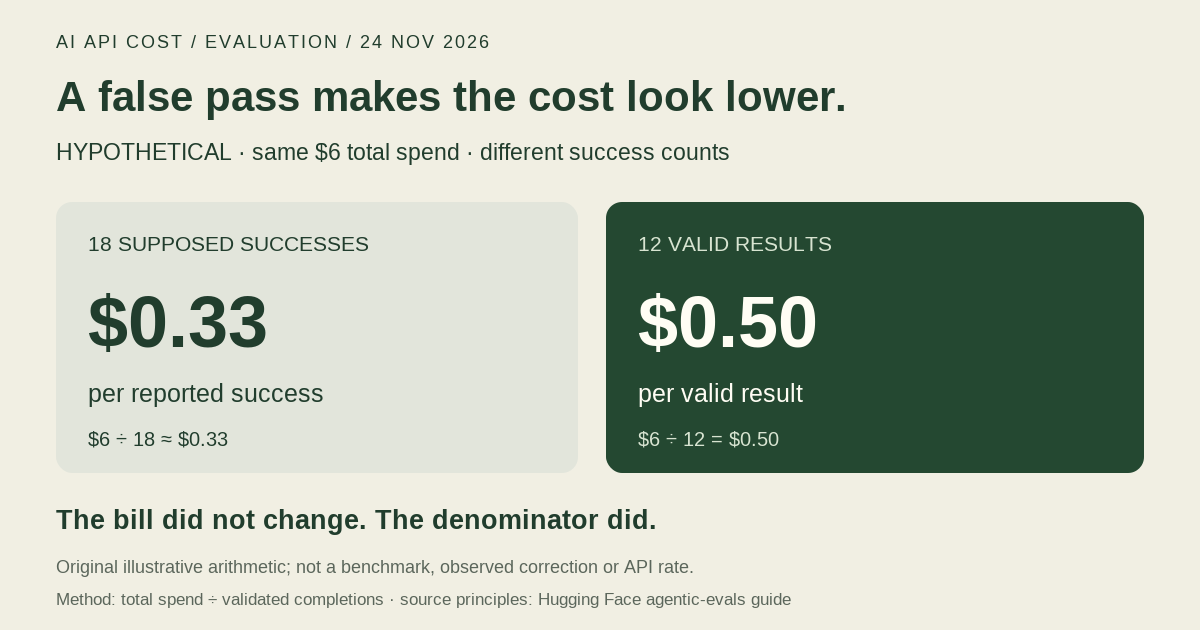
Consider the hypothetical cover: a batch costs $6 and the checker reports 18 successes. Dividing gives about $0.33 per success. If only 12 outputs satisfy the actual task, the same spending represents $0.50 per valid result. The API bill has not increased. The original cost estimate used an inflated success count.
Keep failed attempts and retries in the spending total. Record the model and provider, harness version, task fixtures, grader revision and charged usage alongside the accepted outputs. Review traces for both passes and failures; the final chat message alone cannot establish that an artifact exists or is correct.
When you repair a grader, identify which old scores it affects. Regrade retained outputs where that is possible, or label a fresh run as a new experiment rather than silently comparing unlike verdicts. These controls can expose an invalid comparison; they do not establish statistical confidence or guarantee lower costs. No model calls or paid evaluations were run for this article.
Sources & verification
Provider documentation supports the facts referenced below. Our explanations and recommendations are editorial interpretation.
- Hugging Face: How to build and maintain an agentic evaluation ↗Checked Nov 24, 2026
- burtenshaw/raman-lab dataset card ↗Checked Nov 24, 2026
- Harbor: Verifier ↗Checked Nov 24, 2026
- Anthropic: Demystifying evals for AI agents ↗Checked Nov 24, 2026
Corrections: hello@aiapicost.com