Developer workflow · Reporting
Granite Switch 4.1.1: check the language list before upgrading
IBM's patch changes speech and Decision components without retraining the base model. Its announcement and model cards disagree on language count; here is what to verify.
A compatible patch still deserves a release gate
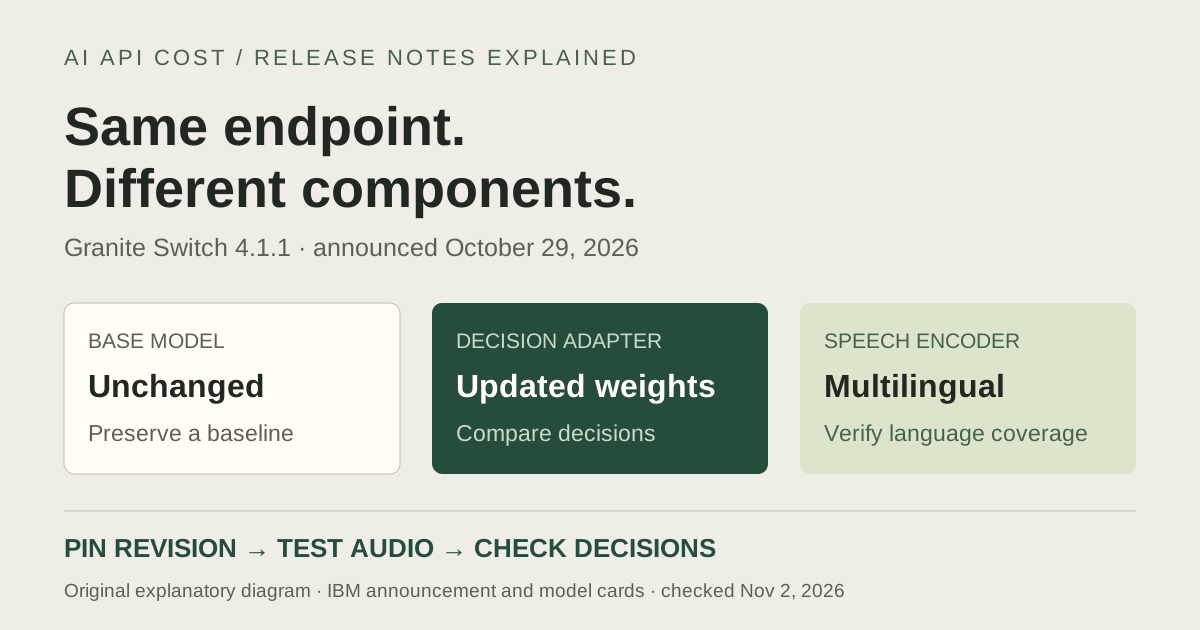
IBM announced Granite Switch 4.1.1 on October 29 as a backwards-compatible patch: the base model stays unchanged while the speech encoder and Decision adapter are updated. For a developer running speech into an automated decision, that raises a more useful question than whether the endpoint still responds: which parts of the result could change?
There is also a concrete documentation mismatch to resolve before expanding coverage. The announcement says the speech update supports ten languages. The linked Switch 30B model card lists seven. An unchanged integration does not settle that difference. Treat the patch as a candidate for your existing release process, not as evidence that every advertised language is ready for your application.
Use the explicit language list, not the larger headline
The seven languages named in the Switch card are English, French, German, Spanish, Portuguese, Italian and Japanese. IBM's October 21 Granite Speech article and the TurboCTC model card give the same list. Those sources also describe punctuated, capitalized transcripts. We found no explicit list of the three additional languages in the patch announcement. This is a source discrepancy, not proof that those languages fail.
If you need a language outside the explicit list, hold that part of the rollout until you can confirm the exact artifact's coverage with the maintainer and evaluate representative recordings. Do not substitute a nearby language or a broader model-family description. A creator transcribing an interview needs names and sentences to survive the pipeline; a language-count headline cannot tell them whether that will happen.
One announcement, two language counts
Scroll sideways to read all columns.
| Primary source | Published claim | How to use it |
|---|---|---|
| Switch 4.1.1 announcement · October 29 | 10 languages | Do not infer which additional languages are supported |
| Switch 30B model card · revision 4.1.1 | 7 languages | Check the exact checkpoint and target language |
| Speech 5.0 article · October 21 and TurboCTC card | English, French, German, Spanish, Portuguese, Italian, Japanese | Use the explicit list to scope an initial evaluation |
Pin the artifact before comparing results
The Switch model card says the repository's main branch carries the latest revision and provides release tags for pinning. A repository name alone therefore does not identify a reproducible baseline. Hugging Face's download guide documents a revision parameter for branches, tags or full commit hashes; snapshot_download can fetch a repository at a chosen revision. Record what your serving process actually loads, alongside the runtime and configuration.
Our suggested trial is deliberately small: preserve the current deployment, prepare a candidate at a recorded revision, and replay a consented set of typical recordings plus known difficult cases. Compare transcripts before inspecting the downstream decisions. Include names, punctuation-sensitive instructions, quiet speech and the languages you intend to offer. These are proposed acceptance checks; we have not run an inference benchmark or validated this patch on customer audio.
A small release gate for a speech-to-decision application
- 1Freeze
Record the current checkpoint revision and serving configuration.
- 2Replay
Compare transcripts and decisions on consented, representative audio.
- 3Promote or hold
Accept only if language coverage and downstream behavior meet your existing criteria.
Measure the whole workflow before claiming savings
For a hypothetical voice-note classifier, a cleaner transcript is useful only if the final label is still right. Keep expected labels fixed between versions and inspect disagreements. Record accepted tasks, failures requiring correction and end-to-end latency. If a candidate changes both transcription and decision behavior, separating those observations helps you decide where a regression entered; the final label alone hides that distinction.
IBM's component update is a development and release mechanism, not a published API price cut. It does not establish what your hosting bill will be. Compare the cost of producing an accepted result, including serving capacity and correction work, using your own deployment's billing units. If the candidate meets your language and decision criteria, promote the recorded artifact. Otherwise keep the working baseline and the failed examples, rather than widening coverage on the strength of the version number.
Sources & verification
Provider documentation supports the facts referenced below. Our explanations and recommendations are editorial interpretation.
- Granite Switch 4.1.1 — Update models like you update software ↗Checked Nov 2, 2026
- IBM Granite Switch 4.1 30B, revision 4.1.1 model card ↗Checked Nov 2, 2026
- IBM: Granite Speech 5.0 ↗Checked Nov 2, 2026
- IBM Granite Speech 5.0 TurboCTC model card ↗Checked Nov 2, 2026
- Hugging Face: Download files from the Hub ↗Checked Nov 2, 2026
Corrections: hello@aiapicost.com