API updates · Reporting
Inkling 2 Mini: check the runtime budget behind the 20GB checkpoint
Thinking Machines' new open-weight model runs locally or through Tinker. Separate checkpoint size, device guidance and context limits before replacing an API workload.
The release makes a local trial possible, not automatically equivalent
Thinking Machines released Inkling 2 Mini on November 20 with downloadable weights and access through Tinker for inference and customization. For someone paying for API calls, the practical question is whether their own recurring workload can move onto an existing machine—not whether a launch demo ran on a laptop.
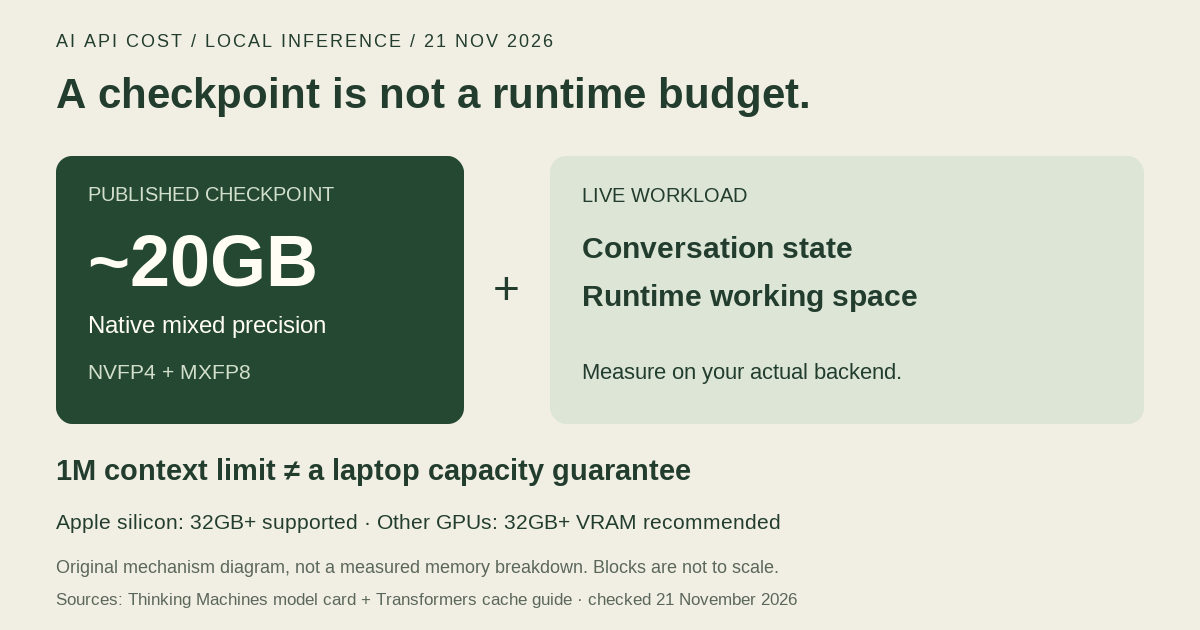
The model accepts text and image inputs and produces text. Its card describes a native mixed NVFP4/MXFP8 checkpoint of about 20GB, with Apple-silicon support starting at 32GB memory and a recommendation of 32GB or more VRAM for other GPUs. Treat those as published hardware guidance, not a measured promise about your longest prompt.
Hugging Face's launch guide offers several runtime paths and distinguishes the fixed-loop model from a separate variable-loop research checkpoint. It also describes a local OpenAI-compatible API through Llama App. That is a route for trying an integration, not proof that every client feature, output format or image path behaves identically to a hosted service.
Budget the live conversation as well as the weights
The 1M-token context window is a model limit, not a statement that the full window fits in the same memory as the downloaded checkpoint. Transformers' cache documentation explains that generation keeps reusable attention state; dynamic caches grow, while sliding-window layers stop growing at their window. Cache strategy changes memory and speed trade-offs.
For planning, separate three questions: can the backend load this checkpoint, can it finish the intended request, and can it do so while the rest of your workflow is running? A successful short answer establishes only the first small case. It says little about a long conversation alongside an editor, browser and another request.
Do not subtract 20GB from 32GB and label the remainder usable context memory. That would mix a published checkpoint size with device capacity while assuming away backend allocations and other processes. The table keeps the quantities separate instead of inventing a maximum token count for a laptop we have not tested.
Three published numbers, three different questions
Scroll sideways to read all columns.
| Published quantity | What it describes | What it does not establish |
|---|---|---|
| About 20GB | Native NVFP4/MXFP8 checkpoint | Peak memory for your complete request |
| 32GB or more | Supported Apple-silicon memory; recommended other-GPU VRAM | An idle 32GB machine with all memory available |
| Up to 1M tokens | Model context-window limit | A 1M-token run fitting on every supported device |
Make the comparison with your actual API task
If you choose to trial it, start with a known-answer text task, then repeat a representative long conversation. Add an image task only if your application needs images. Keep the model, quantization, runtime version, prompt, output cap and simultaneous-request count in the record. Measure peak memory, time to first response, completion time and whether the result passes the same checks as the hosted route.
The model card warns about repetitive reasoning, unreliable agent actions and runtime-dependent local speed. Bound output and agent turns, and keep file-writing tools in a sandbox with confirmation for destructive operations. A model that loads successfully is not yet a dependable unattended coding endpoint.
Compare completed work over the period you actually use it. Count retries and time spent correcting answers; distinguish hardware already owned from a new purchase. Local inference still consumes compute and operating attention, while Tinker remains a separate hosted option. We have not run this model or established a break-even price: the first useful result is a repeatable workload test, not a universal claim that local beats API.
Sources & verification
Provider documentation supports the facts referenced below. Our explanations and recommendations are editorial interpretation.
- Hugging Face: Welcome Inkling 2 Mini ↗Checked Nov 21, 2026
- Thinking Machines Lab: Introducing Inkling 2 Mini ↗Checked Nov 21, 2026
- Thinking Machines Inkling-2-Mini model card ↗Checked Nov 21, 2026
- Transformers: Cache strategies ↗Checked Nov 21, 2026
Corrections: hello@aiapicost.com