API pricing · Reporting
GPT-6.2 API pricing: check the 272K boundary before budgeting
Astra's headline rates fall and Sol's stay unchanged. Long-context requests still change the whole bill: compare the input band and processing mode before extrapolating.
The launch discount is not the complete pricing rule
OpenAI released GPT-6.2 Astra and Sol in the API on November 17. The launch puts Astra's Standard input and output rates 20% below GPT-6 Astra's, while Sol retains GPT-6.1 Sol's rates. For a document-heavy application, the next budgeting question is not simply which model has the smaller price tag. It is whether the actual request qualifies for that quoted rate.
The short-context Standard text rates are $2 per million input tokens and $10 per million output tokens for Sol, versus $8 and $40 for Astra. Those are token prices, not prices for a completed research task or a monthly subscription. OpenAI attributes its lower cost-per-task claims partly to token efficiency. Treat that as a reason to evaluate the models, not a measured saving for your own documents, tool chain or acceptance criteria.
Crossing 272K reprices the full request
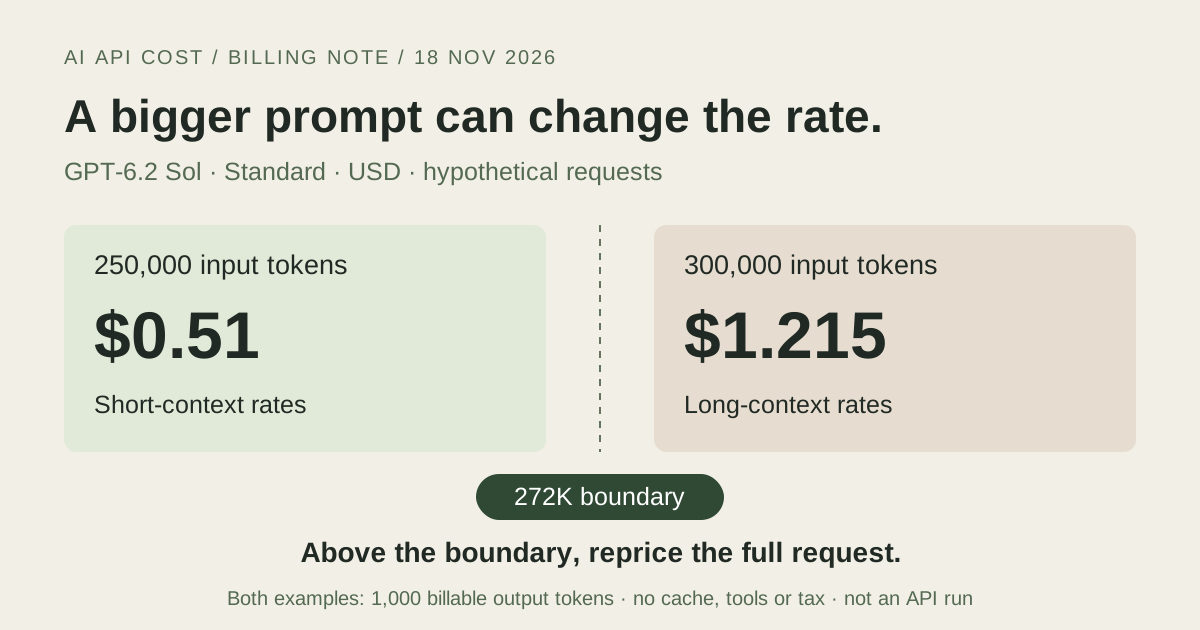
Both model cards list a maximum of 922,000 input tokens, but a request's capacity limit is different from its billing band. With more than 272,000 input tokens, input and cache rates double, and output rates become 1.5 times the short-context rate. The change applies to the full request, not merely the tokens beyond the boundary. A budget that prices every accepted prompt at the short rate will therefore miss a material condition.
In the hypothetical table, each request produces 1,000 billable output tokens. Sol with 250,000 uncached input tokens costs $0.50 for input plus $0.01 for output: $0.51. At 300,000 input tokens, the applicable rates are $4 input and $15 output per million, giving $1.20 plus $0.015: $1.215. Simply extending the short-rate calculation would have produced $0.61. The table applies the same documented rule to Astra; none of these amounts comes from a model run.
Same billable output, different input band
Scroll sideways to read all columns.
| Model | Input tokens | Billing band | Text charge (USD) |
|---|---|---|---|
| GPT-6.2 Sol | 250,000 | Short | $0.51 |
| GPT-6.2 Sol | 300,000 | Long | $1.215 |
| GPT-6.2 Astra | 250,000 | Short | $2.04 |
| GPT-6.2 Astra | 300,000 | Long | $4.86 |
Hold the processing mode fixed before comparing results
The model cards price Batch at half Standard and Fast at twice Standard for the same context length. Ultrafast is a separately dated choice: for both new models it costs three times Standard through February 28, 2027, then six times Standard from March 1, Pacific time. Do not lift an input price from one mode and an output price from another, or treat the introductory Ultrafast multiplier as permanent.
For a small evaluation, group representative requests into input-length bands and record the model, processing mode, cached usage, billed output and paid attempts alongside whether the result was acceptable. Include the applicable cache-write and tool charges when reconciling actual spend; they are not in this text-only table. Compare cost per accepted result only after applying the same quality criteria. Shortening a prompt can change its price band, but removing necessary source material can also make its answer unusable. Test that trade-off rather than trimming blindly to a threshold.
Sources & verification
Provider documentation supports the facts referenced below. Our explanations and recommendations are editorial interpretation.
- OpenAI: Introducing GPT-6.2 Astra and Sol ↗Checked Nov 18, 2026
- OpenAI API pricing ↗Checked Nov 18, 2026
- GPT-6.2 Sol model card ↗Checked Nov 18, 2026
- GPT-6.2 Astra model card ↗Checked Nov 18, 2026
- OpenAI API changelog, November 17 ↗Checked Nov 18, 2026
Corrections: hello@aiapicost.com