API pricing · Reporting
Budgeting Gemini 4: Argon's price deadline and Carbon's access gap
Google's November 2 roundup puts Argon and Carbon together. For API planning, separate Argon's dated introductory rates from Carbon's limited pre-release access.
Two models in a roundup are not two buying options
Google's November 2 AI roundup brings Gemini 4 Argon and Carbon into the same update, but describes different release states: Argon has rolled out broadly, while Carbon remains in pre-release testing with selected participants. If you are choosing an API for a project that must ship this month, availability is the first filter, not benchmark position.
There is a separate budget deadline for the model you can already evaluate. Argon's published Standard paid-tier prices have a November 30 cutoff. A trial invoice at the introductory rate is not a forecast for a December workload. Keep those two questions apart: can this account use the model, and which dated rate applies when the work actually runs?
Use a dated rate card, not a launch headline
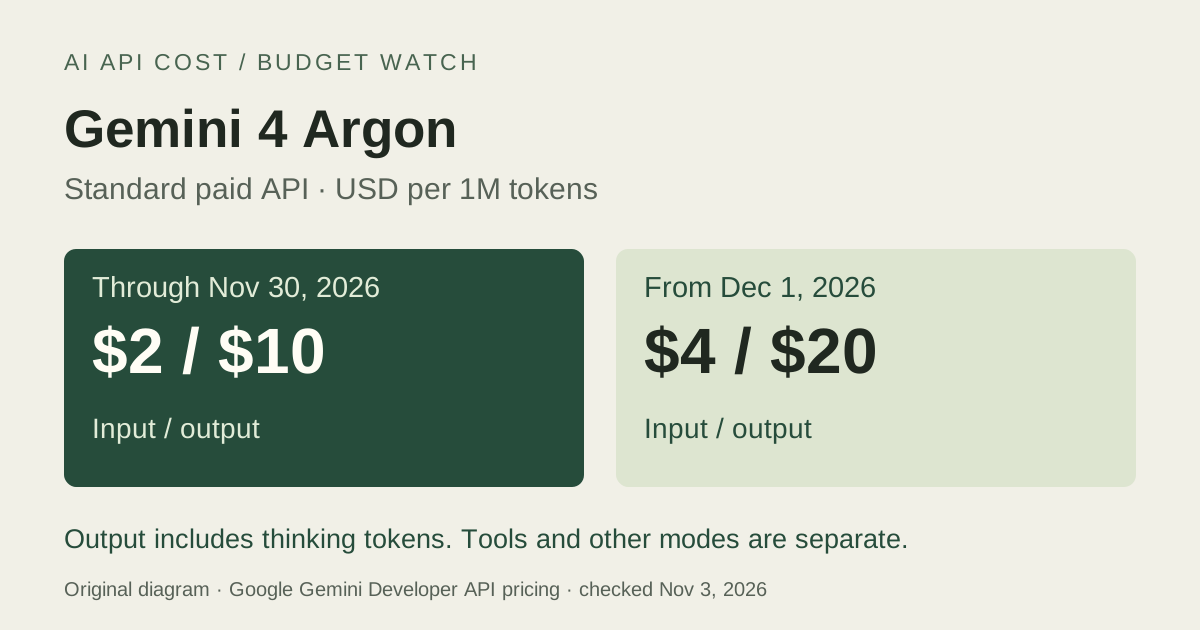
The Gemini Developer API pricing page lists Argon at $2 per million input tokens and $10 per million output tokens through November 30, 2026; from December 1 it lists $4 and $20. Output billing includes thinking tokens. The page says Argon is not offered on the Free tier.
For a hypothetical workload of ten million input tokens and two million total billed output tokens, those Standard token charges are $40 before the cutoff and $80 afterward. This arithmetic excludes tools and other charges; it is not a measured customer bill. Put both periods in a project estimate instead of extending a discounted trial month indefinitely. Record the delivery mode alongside the model so another person can reproduce the estimate.
Argon Standard API: put both dates in the budget
Scroll sideways to read all columns.
| Billing item | Through Nov 30, 2026 | From Dec 1, 2026 |
|---|---|---|
| Input | $2.00 | $4.00 |
| Output, including thinking | $10.00 | $20.00 |
Carbon's announced price is not self-service access
Google's October 28 Carbon announcement describes initial access for a subset of cyber defenders and trusted partners through the Fairwind Program, ahead of broader product availability. It also announces introductory pricing. Neither a published future price nor a model's appearance in a roundup establishes that an ordinary developer account can call it now.
Our recommendation is to keep Carbon in a watchlist rather than make it a required dependency for a scheduled launch. If you are admitted to a testing program, record the actual access conditions separately. If not, evaluate a model available on your intended API surface. A fallback plan is only useful when its model, authentication path and operating constraints are known; a promising announcement cannot fill those fields.
Check access before comparing a replacement model
- 1Identify the surface
Record API, consumer app or partner testing; these are not equivalent access.
- 2Verify eligibility
Argon has a documented API model ID. Carbon is described as limited pre-release testing.
- 3Then evaluate
Confirm actual access, workload compatibility and applicable rates before budgeting a migration.
Check the capability contract before moving the workload
Argon's model reference identifies gemini-4-argon as a stable model code and specifies text output. Its caching support is implicit only; explicit caching is not supported. Those details matter when an application assumes it can create and manage a reusable cache object or needs generated media rather than text. A family name does not guarantee that every endpoint supports the same workflow.
Before a migration, write down the endpoint, model ID, required outputs, caching behavior and the date on which the rates were checked. Then run your normal acceptance cases within an approved budget, preserving failures as well as successes. This article supplies a planning distinction, not an inference test or a recommendation to switch providers. Use the available API and its dated terms for the current decision; revisit Carbon when your actual access changes.
Sources & verification
Provider documentation supports the facts referenced below. Our explanations and recommendations are editorial interpretation.
- Google: October 2026 AI roundup ↗Checked Nov 3, 2026
- Google: Gemini 4 Carbon announcement ↗Checked Nov 3, 2026
- Google: Gemini 4 Argon model reference ↗Checked Nov 3, 2026
- Google: Gemini Developer API pricing ↗Checked Nov 3, 2026
- Google: Gemini 4 Argon launch ↗Checked Nov 3, 2026
Corrections: hello@aiapicost.com