API pricing · Reporting
Gemini Decisions API: when to group checks into one request
Google’s new endpoint scores independent questions against shared input. See the token arithmetic, dependency limit and confidence trap before replacing repeated calls.
One document, several checks
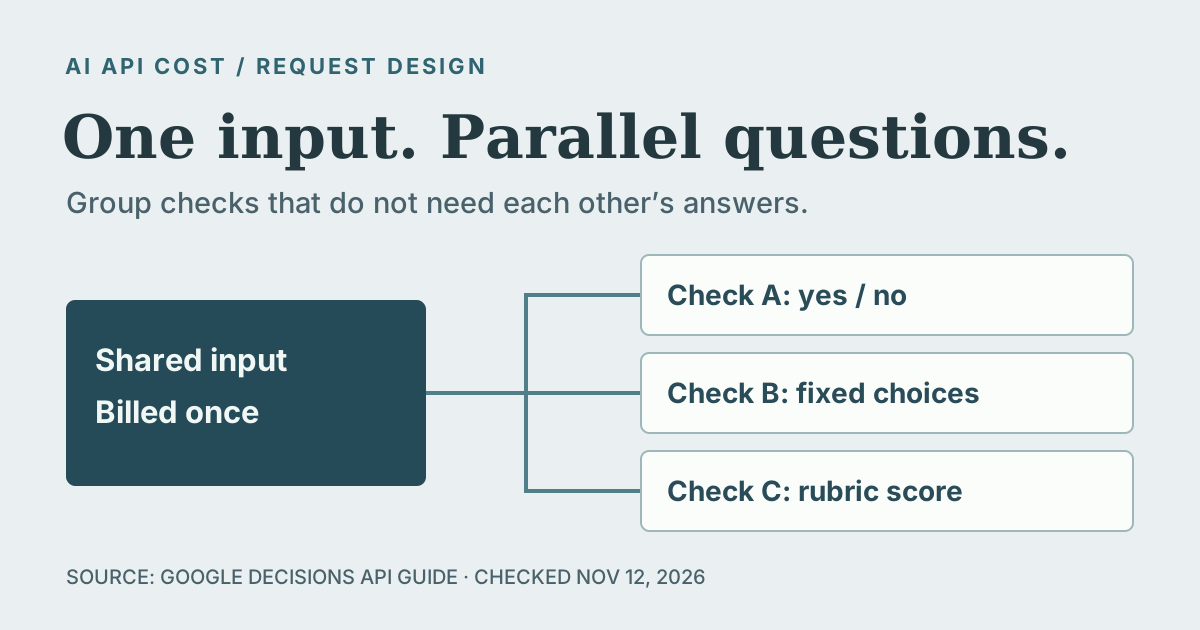
Google introduced the Gemini Decisions API on November 11. Its gemini-decision-1 model returns bounded judgments rather than generated prose: yes/no probabilities, selections from fixed choices and scores against an ordered rubric. For an application that keeps sending the same document to answer separate checks, the billing detail matters: shared input is counted once within a request, while each question contributes its own tokens.
A request can include up to 1,000 questions within a combined 262,144-token context window. But each question sees only the shared input, not the other answers. Checking whether a document mentions a refund and classifying its topic can run together. Choosing a follow-up question based on the first answer is a different workflow: make a second call, or ask all relevant checks and combine the results in application code.
Question tokens still count
The published paid Standard rate is $0.10 per million input tokens, with zero output tokens. Instructions, criteria and formatting for questions are still billed input. In the hypothetical table, grouping twenty independent checks reduces repeated document tokens, not the amount of question text. It does not estimate what a particular PDF or image will tokenize to.
This is not the Batch API discount or a cache hit. The Decisions guide says context caching, Batch, Flex and Priority are unsupported, and repeating input across separate requests counts it again in full. Inspect usage.total_input_tokens on the response instead of estimating a production bill from file size. Add any later generative call to the workload total; scoring the document does not write the explanation your user may still need.
Twenty checks on one document: hypothetical input charges
Scroll sideways to read all columns.
| Request design | Shared-input tokens billed | Question tokens billed | Input charge (USD) |
|---|---|---|---|
| One request, 20 questions | 10,000 | 2,000 | $0.00120 |
| 20 requests, one question each | 200,000 | 2,000 | $0.02020 |
A confident answer can be no
For a yes/no question, noul is the probability of yes. Confidence is the larger of that probability and its complement, so high confidence can mean a strong no. Do not use confidence alone as the positive condition. For fixed choices, include an explicit catch-all or a separate scope check: the API distributes probability among your options even when none fits.
Choose routing thresholds using labeled examples from your own traffic, including ambiguous and out-of-scope documents. Track wrong automatic decisions separately from the share sent to review. A cheaper check that confidently selects an unsuitable action does not save the downstream work of correcting it.
Check capacity separately from price
Before moving a queue, check the project's active limits in AI Studio. Google applies rate limits per project rather than per API key, across dimensions such as requests and input tokens. Grouping questions changes those counts but does not remove the limits. Keep a bounded fallback for rejected requests and record how many checks actually complete before your processing deadline.
Sources & verification
Provider documentation supports the facts referenced below. Our explanations and recommendations are editorial interpretation.
- Google: Gemini Decisions API — fast, calibrated multimodal decisions ↗Checked Nov 12, 2026
- Google AI Studio: Decisions API guide ↗Checked Nov 12, 2026
- Google AI Studio: Gemini Decision pricing ↗Checked Nov 12, 2026
- Google AI Studio: Rate limits ↗Checked Nov 12, 2026
Corrections: hello@aiapicost.com