API updates · Reporting
Hugging Face switches chat routing: check the bill, not just the token
OpenRouter now routes language-model requests on Hugging Face. Custom provider keys stop working on that path; routing policy and the billed account need separate checks.
Your token can stay while the payment path changes
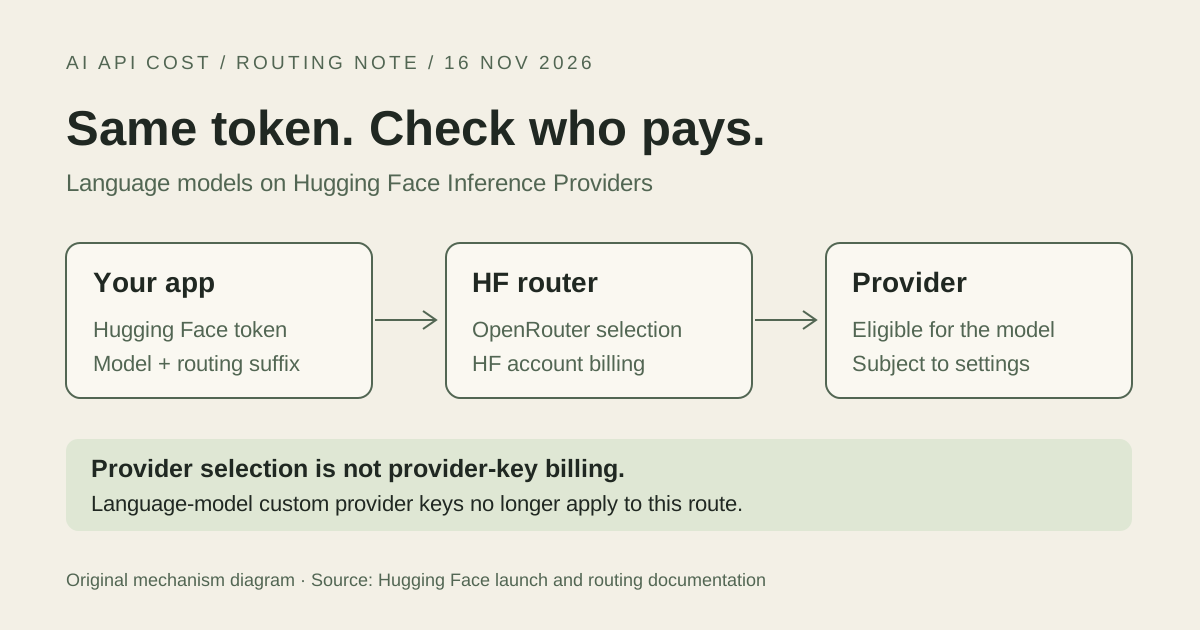
Hugging Face switched language-model requests on Inference Providers to OpenRouter on November 16. Existing HF tokens and client code can keep working, but one billing assumption breaks: language models on this route no longer accept your own provider API key. Those requests are charged to your HF account or organization. A successful response therefore does not establish that the same company still bills your application directly.
Start with the payer in your request configuration. Hugging Face documents X-HF-Bill-To for organization billing and bill_to in its Python client. Organization-billed requests use that organization's enabled-provider settings rather than the caller's personal selection. If you previously reconciled a provider invoice against these calls, check the HF usage breakdown instead. The launch says custom keys for image and video providers remain supported; it does not move those tasks through the new language-model router.
Default routing is not a lowest-price promise
OpenRouter's launch describes automatic retries across providers inside the same call. Its cited October routing experiment improved reliability and speed at a higher average cost per request, not a universal discount. Treat that as OpenRouter's reported experiment rather than a forecast for your prompts. The practical question is whether the selected policy fits your application's trade-off between price, response time and acceptable failures.
The HF routing guide distinguishes the unsuffixed default from :cheapest and :fastest. Default selection considers effective price, cache behavior, speed and reliability; :fastest targets throughput, which is not the same measure as time to first token. A named provider suffix pins the request, and a pinned provider is not replaced on failure. Disabling providers also constrains the available choices. Keep the policy in the same record as the model ID when comparing runs.
Separate payment from provider selection
Scroll sideways to read all columns.
| Choice | What it controls | What it does not establish |
|---|---|---|
| HF account or organization | Who pays for routed usage | Which provider is cheapest |
| :cheapest suffix | Lowest-price routing policy | Your complete workload cost |
| A provider suffix | One specific provider | Failover to another provider |
Reconcile a small workload before moving the budget
The billing guide says HF passes through provider costs without an added markup. It lists $2 monthly compute credits for PRO accounts and $2 per seat for Team or Enterprise organizations, shared with other HF compute services rather than reserved entirely for chat. Free accounts need purchased credits. No added markup is a statement about the billing layer, not proof that default routing chooses the lowest listed rate or that a subscription covers a production workload.
For an acceptance check, choose a small set of representative requests and record the billed account, model, routing suffix, input and output tokens, and whether the answer meets your application's requirements. Then compare the provider-level usage entries with that record. Include your retry policy and cache conditions before extrapolating a monthly total. This is a proposed check, not a benchmark we ran. If a fixed provider is mandatory, verify its enabled status and failure handling rather than assuming that automatic failover still protects that pinned request.
Sources & verification
Provider documentation supports the facts referenced below. Our explanations and recommendations are editorial interpretation.
- Hugging Face and OpenRouter join forces to make open-weight models easy to run ↗Checked Nov 17, 2026
- OpenRouter Now Powers Inference on Hugging Face ↗Checked Nov 17, 2026
- Hugging Face Inference Providers: Pricing and Billing ↗Checked Nov 17, 2026
- Hugging Face Inference Providers: Routing and Providers ↗Checked Nov 17, 2026
Corrections: hello@aiapicost.com