API updates · Reporting
GPT-6-Cyber API: who can use it, and what should a pilot cost?
Check Daybreak Red and model approval, project access and network setup before budgeting GPT-6-Cyber. A worked example prices a verified finding, not just one call.
A listing is not an access grant
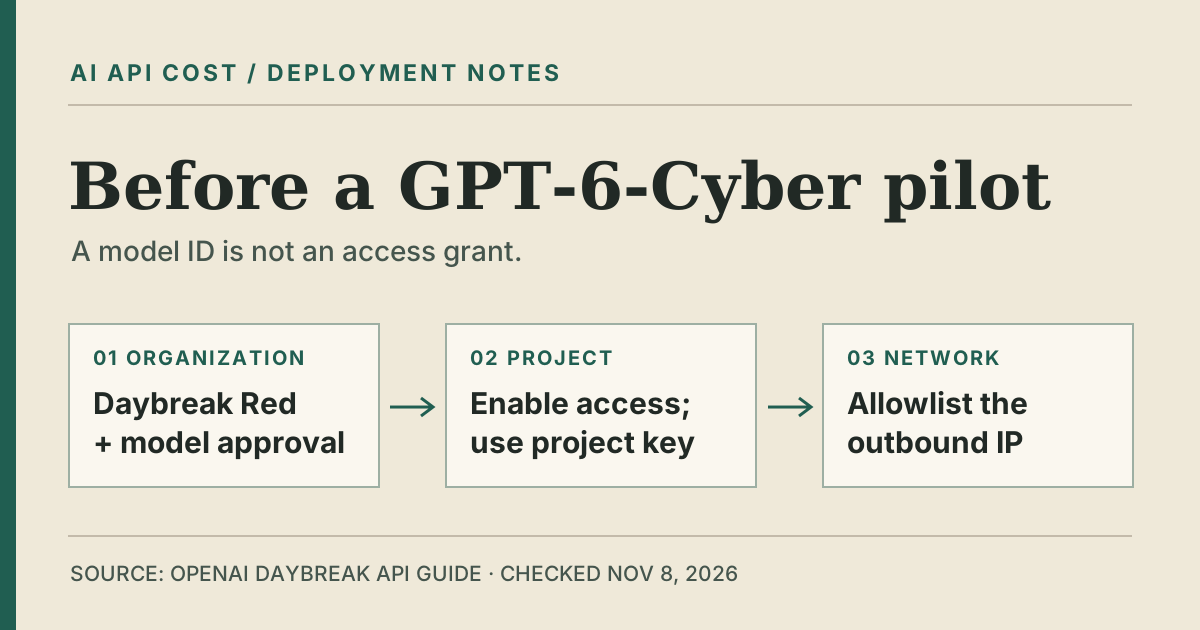
OpenAI added GPT-6-Cyber to its API changelog on November 5 for tasks such as investigating a vulnerability and verifying a fix in an authorized environment. If you want to try it against a patch in your own staging system, confirm access before estimating a rollout. The model needs both Daybreak Red and separate GPT-6-Cyber approval. Knowing the model ID does not establish that your organization can call it.
Ask your account team to confirm both approvals. The Daybreak guide says Red organizations must require single sign-on for the API organization with Cyber access and enforce multifactor authentication through their identity provider. Even after approval, the project sending requests needs access to the program and model.
Check the worker that will make the request
With project-level controls, use a non-default project with Daybreak Red enabled and a key issued by that project. The public IP your application uses to reach the API must be allowlisted. Check the egress IP of the actual job runner, not the laptop where you prepared the request. If the project uses Zero Data Retention, OpenAI also requires Private Safety Processing and says to verify its storage validation and retention setting.
The documented Responses API request uses model gpt-6-cyber and sets access_programs.cyber to daybreak_red. That field selects a program; it cannot grant a permission. If you see the 403 access_program_not_enabled error, check the project behind the key and the organization's approval before retrying.
Budget for the patch check, not the first response
The standard short-context list rates are $20 per million uncached text input tokens and $100 per million billed text output tokens. Cached input is $2 per million; writing to the cache is a separate price category. For a small pilot, start with the uncached estimate and count each call the case needs. In the example below, the first review costs $0.60 in tokens, but one follow-up brings the case to $1.40 before tools and staff time.
Pick a fixed set of already-authorized staging cases and define what counts as a useful result before spending: for a patch, a regression test should fail against the old build and pass against the fixed build. Record which build and model version each case used so that you can repeat it. Add the token cost of all attempts, any tool charges and the reviewer time converted to dollars, then divide by the number of cases you accept. If none pass, report the spend and zero accepted cases rather than a cost per success. An inexpensive first reply tells you little if the reviewer still has to write the test.
A hypothetical patch-verification budget
Scroll sideways to read all columns.
| Attempt | Input tokens | Billed output tokens | Token cost (USD) |
|---|---|---|---|
| Initial review | 20,000 | 2,000 | $0.60 |
| Follow-up | 20,000 | 4,000 | $0.80 |
| Both attempts | 40,000 | 6,000 | $1.40 |
Sources & verification
Provider documentation supports the facts referenced below. Our explanations and recommendations are editorial interpretation.
- OpenAI API Changelog: November 5 GPT-6-Cyber entry ↗Checked Nov 8, 2026
- OpenAI: Use Daybreak in the Responses API ↗Checked Nov 8, 2026
- OpenAI: GPT-6-Cyber model reference ↗Checked Nov 8, 2026
- OpenAI API pricing: Cyber models ↗Checked Nov 8, 2026
Corrections: hello@aiapicost.com