Developer workflow · Reporting
llama.cpp 1.0: three checks before upgrading a local API
The release makes public C API changes explicit. Test native bindings, server startup and actual HTTP completions separately before replacing your working build.
The version boundary names the public C API
The llama.cpp maintainers released v1.0.0 on November 13, alongside ggml v1.0.0. Their versioning announcement ties major bumps to breaking changes in the public C API under include, minor bumps to compatible features and additions, and patches to fixes without API changes. For an application using a local model server, that is useful release information, not a substitute for testing the interface your client actually uses.
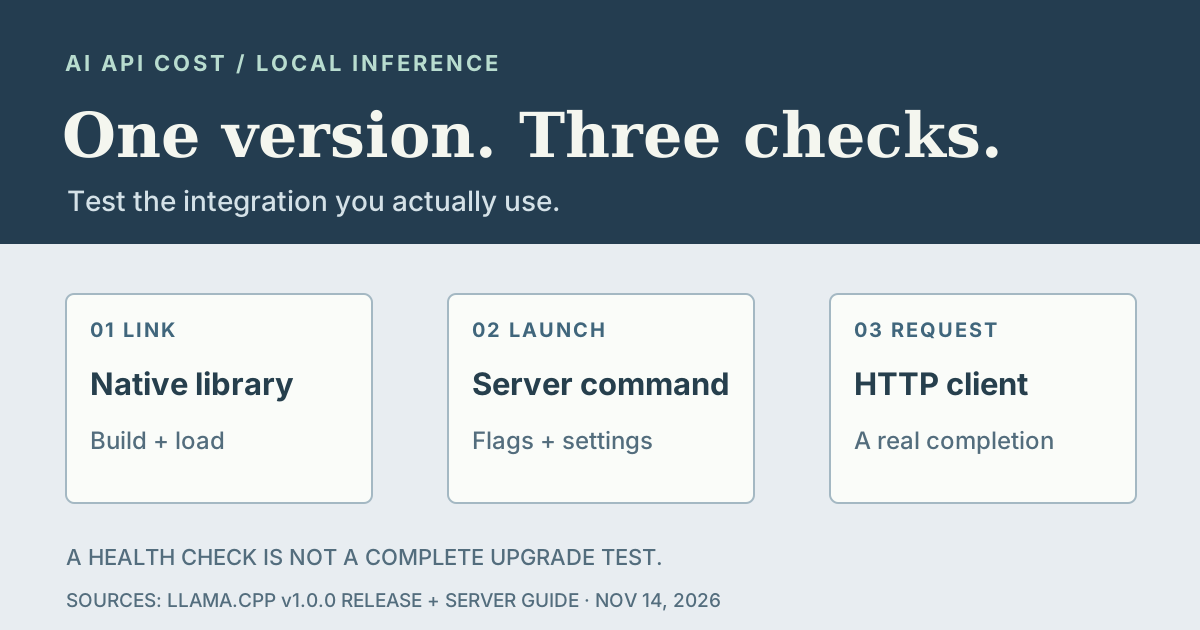
Native wrappers need their own check. The release removes deprecated functions including llama_set_warmup, and moves the NextN interface into llama.h while renaming llama_set_embd_state_src to llama_set_ctx_state_src. If your code or binding calls the old names, starting a new server binary does not establish that the wrapper builds or loads. Keep the wrapper and the library version it was built against together when testing.
Replay the real launch command
The same removal change drops the deprecated --defrag-thold option. Search your startup scripts and saved service configuration for old flags before replacing the executable. Use a separate local port for the candidate build and the same model file, template and relevant settings as the working version. Otherwise, a changed default can get mistaken for a model-quality regression.
Check network and authentication settings explicitly as well. The tagged server guide lists loopback listening as the default and provides an explicit port setting. If you configured an API key, verify that a protected completion rejects missing or incorrect credentials. Do not weaken authentication or enable unauthenticated tools just to make a smoke test pass; changing exposure and upgrading the inference engine are different changes.
Match the upgrade test to your integration
Scroll sideways to read all columns.
| Integration | Check | A misleading pass |
|---|---|---|
| Native binding | Build and load against the intended libllama | A separate llama-server binary starts |
| Launch script | Run the actual flags and inspect effective settings | The new binary prints its version |
| HTTP client | Complete a representative request and consume its output | GET /health returns 200 |
A healthy process has not tested your client
In the v1.0.0 server guide, GET /health is public and a 200 response means the model is loaded and the server ready. It does not prove authentication works, a chat template is suitable, or your application can parse a completion. The guide distinguishes the native /completion route from the compatible /v1/completions and /v1/chat/completions interfaces, so use the route your application really calls.
Send a representative request through the existing client and consume the response all the way through. If you use streaming, check the end of the stream and cancellation; if you require structured output, validate the result against your schema. Include one deliberately invalid request to check that your client reports an API error rather than treating it as an empty model answer. Record the executable version, model artifact and launch configuration with that check. Keep the known-working build available until the candidate passes, so a failure can be isolated without also changing models or rewriting the client.
Sources & verification
Provider documentation supports the facts referenced below. Our explanations and recommendations are editorial interpretation.
- llama.cpp maintainers: v1.0.0, a stronger foundation for the local AI ecosystem ↗Checked Nov 14, 2026
- llama.cpp v1.0.0 release notes ↗Checked Nov 14, 2026
- llama.cpp: remove deprecated APIs and promote NextN declarations ↗Checked Nov 14, 2026
- llama.cpp server guide at v1.0.0 ↗Checked Nov 14, 2026
Corrections: hello@aiapicost.com