Developer workflow · Reporting
Granite’s LLMON previews: task bindings are not tool permissions
IBM’s experimental models separate instructions from input data. Understand what exec flags select, what remains in context, and what your application must enforce.
A different interface to the model
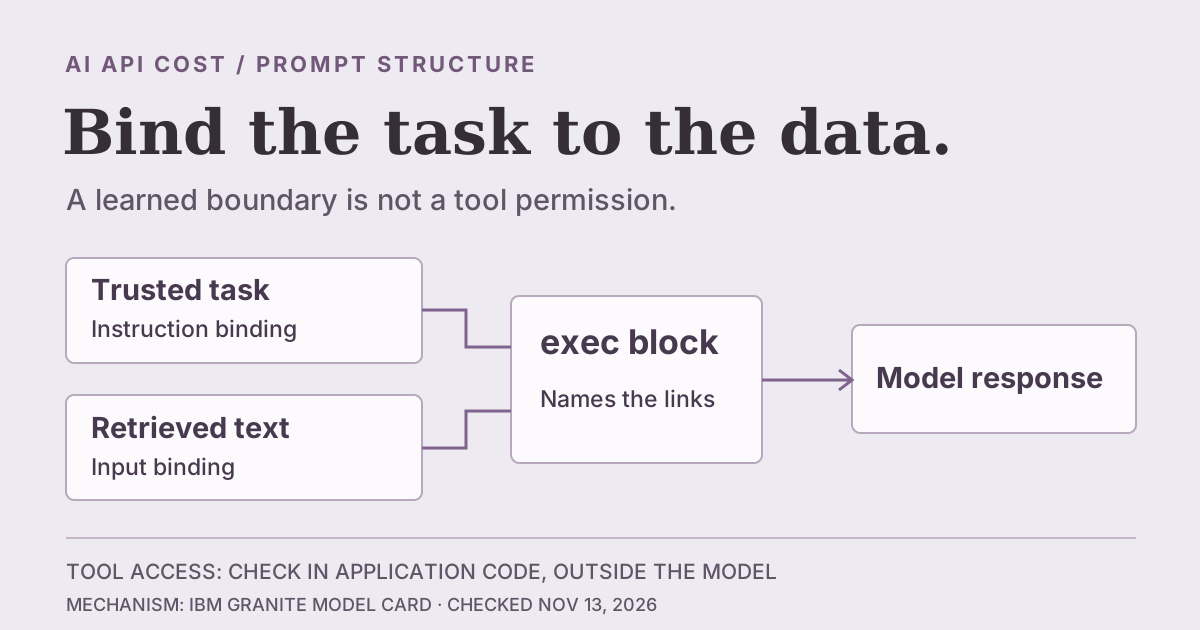
IBM released experimental Granite 4.1 3B and 8B LLMON previews on November 12. They are trained to read and write LLM Object Notation: a format that gives prompt components explicit boundaries and identifiers. For a retrieval application, the practical change is that an instruction can point to the document it should use instead of leaving the model to infer the relationship from one long string.
The 8B model card says to use its bundled chat template rather than a conventional chat format. Its blocks distinguish instructions, data, documents, requirements and other components. An exec block then names the instruction, relevant inputs and destination for the response. The name refers to a binding in the model context; it is not a shell command or an authorization system for your tools.
Selected data is still data
The release’s messages examples give individual parts an exec flag. Marking a data component True binds it as an input, not as an instruction. That matters when a retrieved document contains imperative wording: the task may require reading that wording without carrying it out.
False has a different meaning from removal. IBM says that an unselected component is still rendered into the context but is not referenced by the execution block. If a stale document is unnecessary for the task, omit it rather than assuming the flag saves its context space. Keep relevance selection separate from deciding which text is trusted to instruct the model.
The flag selects a binding, not a permission
Scroll sideways to read all columns.
| Prompt component | How it is referenced | What it does not mean |
|---|---|---|
| instruction, exec=True | Task instruction | Permission to invoke any external tool |
| data, exec=True | Input to the task | A command to obey |
| data, exec=False | Rendered, but not bound into exec | Deleted text or zero context cost |
Test with a harmless competing instruction
For a local evaluation, choose a short document with a known summary and a trusted task asking for that summary. Add a sentence inside the document asking the model to return a fixed marker instead. Compare the clean and modified documents using the preview’s actual template, and record whether the requested summary remains correct. This is a proposed test, not a result from running these models.
Include a case where the same competing sentence arrives as a tool result and another where it reappears in a later turn. IBM’s release notes that the cited prompt-injection benchmarks use static attacks and that adaptive, multi-turn attacks remain a work area. Use stub tools during evaluation so a mistaken model choice has no external effect.
Keep the application’s checks
The model card describes the privilege distinction as learned behavior, not an enforced guarantee. Keep permission and argument checks in application code before executing any suggested tool call. If you compare the preview with your current model, count malformed outputs and correction attempts alongside task accuracy. Measure the tokenized, rendered prompt and complete request sequence before making a cost claim; adopting a structured format alone does not establish a cheaper workflow.
Sources & verification
Provider documentation supports the facts referenced below. Our explanations and recommendations are editorial interpretation.
- IBM Granite: LLMON, an LLM-native markup language, now in Granite 4.1 3B and 8B ↗Checked Nov 13, 2026
- IBM Granite 4.1 8B LLMON preview model card ↗Checked Nov 13, 2026
- Hind et al.: LLMON, an LLM-native markup language to leverage structure and semantics at the LLM interface ↗Checked Nov 13, 2026
- Shbita et al.: Post-training large language models with LLMON ↗Checked Nov 13, 2026
- LLMON project: conversion tools and examples ↗Checked Nov 13, 2026
Corrections: hello@aiapicost.com