Developer workflow · Practical guide
Before changing a voice API, check which page the agent found
IBM's CUGA voice-agent report exposes a quiet cross-language retrieval failure. Use text-only controls to separate source selection from speech errors.
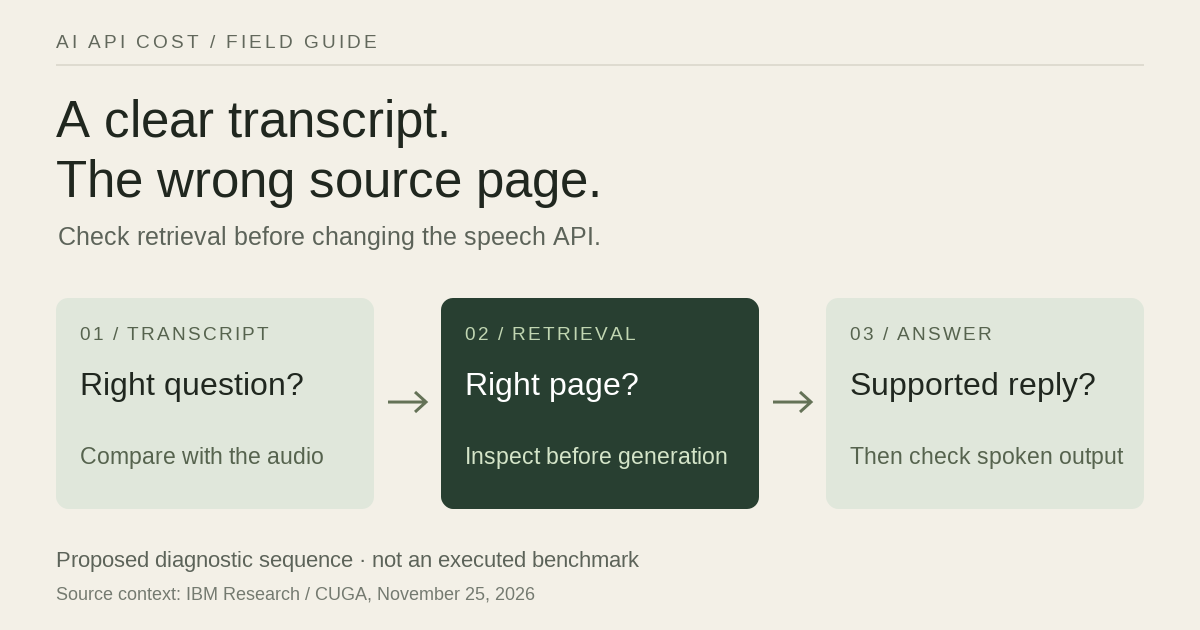
A speech problem can start after transcription
IBM Research's November 25 CUGA voice-agent report describes a failure that a fluent spoken answer can hide. Questions in Hindi or Tamil retrieved irrelevant passages from an English handbook when the application used an English-only embedder. The answering model then treated the requested information as absent. The authors report switching to multilingual-e5-large to address the retrieval mismatch.
For someone choosing speech APIs, the immediate question is narrower than which provider supports more languages: does the correct text question find the correct source? If not, swapping the recognizer or the voice cannot establish that the knowledge search works. Separate those stages before paying for a larger comparison.
Test the text path before the microphone path
Start with a non-sensitive document you can check by hand. Choose a passage with one unambiguous answer, write a question in the document's language, and ask a fluent reviewer for an equivalent question in the user's language. Keep the expected passage identifier beside both inputs. This is a proposed diagnostic, not a language-coverage benchmark.
CUGA's knowledge documentation exposes direct search through agent.knowledge.search(), including filename, page and text fields. That makes it possible to inspect retrieved evidence without judging a generated answer first. Its documentation also identifies the default local embedding model as BAAI/bge-small-en-v1.5. Check the actual deployment configuration rather than assuming the demo and your installation use the same embedder.
Run the paired text questions against the same document revision and retrieval settings. If the document-language question fails too, inspect extraction and chunking before attributing the problem to language. If only the translated question fails, cross-language retrieval becomes a specific hypothesis. The table keeps these observations separate from the later speech check.
Four controls before a speech-provider comparison
Scroll sideways to read all columns.
| Input | Inspect | What a mismatch suggests |
|---|---|---|
| Known-answer question in the document's language | Expected passage appears among retrieved chunks | Ingestion or retrieval needs attention before adding speech |
| Same question in the user's language, typed | Same supporting passage remains retrievable | Cross-language retrieval, not transcription, is a candidate failure |
| Spoken version of that question | Transcript preserves the intended meaning | Speech recognition adds a separate failure to investigate |
| Question whose answer is absent | System does not invent support from unrelated chunks | Answer grounding or abstention needs attention |
A multilingual model still has an input contract
The multilingual-e5-large model card requires query: and passage: prefixes for asymmetric retrieval, including non-English inputs. It also warns that long text is truncated at 512 tokens and that low-resource languages can perform worse. A multilingual label is not a promise that every question, dialect or document will retrieve equally well.
When evaluating a replacement embedder, check both query preparation and document preparation. Re-embed the corpus with the chosen model and matching preprocessing; do not compare new query vectors with an old model's document vectors. Keep an export or a separate test index so the original configuration remains available for comparison. CUGA's storage documentation treats embedding configuration separately from the SQLite-versus-Postgres backend choice: changing where vectors live is not the same experiment as changing how they are produced.
Only then compare the full voice route
Once the text controls behave as intended, add recorded questions with permission and inspect the transcripts. Then check whether each answer is supported by the retrieved passage and whether the spoken output preserves it. A correct transcript, a relevant page and an understandable answer are different acceptance conditions; retain the failed stage instead of recording one undifferentiated success flag.
For a later cost comparison, record charged speech input, generated speech output, model usage, embedding work and retries for the complete route. Compare that spending against answers that meet your acceptance conditions. A cheaper recognizer is not automatically a cheaper working assistant. This article reports no provider prices or latency measurements and ran no speech APIs, model inference or paid tests.
Sources & verification
Provider documentation supports the facts referenced below. Our explanations and recommendations are editorial interpretation.
- An Indic Voice Agent with CUGA ↗Checked Nov 26, 2026
- CUGA: Knowledge Base ↗Checked Nov 26, 2026
- intfloat/multilingual-e5-large model card ↗Checked Nov 26, 2026
- CUGA: Storage Backends ↗Checked Nov 26, 2026
Corrections: hello@aiapicost.com