Cost engineering · Practical guide
A three-pass document parser does not mean three API calls
NVIDIA's new Nemotron Parse write-up separates faster decoding from extra page analysis. Count retained crops and completion failures before budgeting document extraction.
Faster decoding and fewer requests are different changes
NVIDIA's November 26 Nemotron 3.5 Parse write-up adds training resources and explains faster inference with DFlash2. For a document-extraction budget, the useful distinction is that decoding acceleration does not remove the extra analysis performed by double- or triple-pass parsing. A pass names a processing stage, not a promise that the page needs exactly that many model calls.
The current model card separates these choices explicitly: a speculator speeds token generation within requests, while the parsing mode determines which image-analysis stages run. Before comparing a hosted parser with your own deployment, ask what one billed page includes. A whole-document endpoint may package that internal work; a lower-level model endpoint may expose the individual calls. The provider's actual billing contract decides, not the mode's name.
Crops make the request count variable
In the documented pipeline, single pass analyzes the full page. Double pass then revisits predicted table and chart regions as crops. Triple pass adds independent layout detection and refines the retained union of regions from parsing and detection. Each retained crop is a separate request. More passes can also find different regions, so the crop count is not necessarily constant across modes.
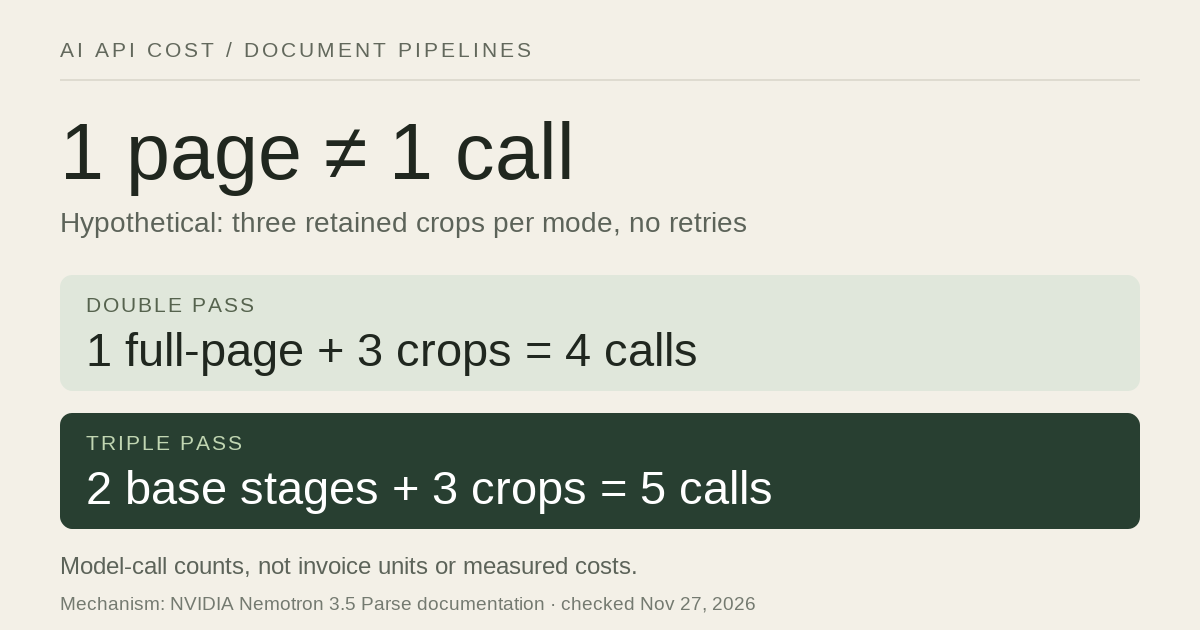
Consider the cover's hypothetical page, with exactly three retained crops in either mode. Double pass requires one full-page call and three crop calls: four model calls. Triple pass adds detection: five calls. For 100 such pages, those assumptions imply 400 or 500 calls before retries, not 200 or 300. These are workload counts, not a claim that either route costs four or five times a single-page tariff.
Use the table to make a small request ledger. Record the page identifier, mode, retained crop count, completed stages and retry attempts. Keep full-page and crop usage separately where the API exposes it: a crop's input and output sizes need not equal the full page's. If the service only reports per-page charges, retain that billing unit rather than inventing token rates.
Count the work inside one page
Scroll sideways to read all columns.
| Mode | Work performed | Calls before retries |
|---|---|---|
| Single | Full-page parsing | 1 |
| Double | Full-page parsing, then each retained table/chart crop | 1 + R |
| Triple | Full-page parsing, independent detection, then retained region-union crops | 2 + R |
A throughput number needs its measurement boundary
NVIDIA's DFlash2 pass-mode reference measures prepared page images on one H200 in BF16, over 2,078 pages and three trials per configuration. Its inference clock includes HTTP, queueing and dependent crop preparation, but excludes initial page preparation, startup, warmup, output writing and final rendering. That is not an end-to-end PDF ingestion rate.
For your comparison, start the wall clock at the input your application actually receives and stop when usable structured output is available. Include rendering, transfer and postprocessing if your route needs them. Record the concurrency and serving profile beside the result. Do not turn a batch-throughput result into a promise about one interactive page, or combine timings from different hardware protocols.
Completion still needs a separate check
The parser's postprocessing guide distinguishes partial output from completion. Strict handling raises GenerationError for token-limited or otherwise invalid generation. With allow_partial enabled, affected documents carry complete=False and warnings; truncated crops are not used for refinement. A finished batch therefore need not contain a complete extraction for every input page.
Choose a small representative sample before changing the production mode. Check required rows, columns and fields against the source pages, and retain incomplete cases in the workload and retry total. Then compare spending per accepted extraction under the same requirements. This is a proposed evaluation plan: no GPU job, document inference, paid API test or provider-price measurement was run for this article.
Sources & verification
Provider documentation supports the facts referenced below. Our explanations and recommendations are editorial interpretation.
- NVIDIA: Building on Nemotron 3.5 Parse ↗Checked Nov 27, 2026
- NVIDIA Nemotron 3.5 Parse model card ↗Checked Nov 27, 2026
- NVIDIA Parse: Parse documents and export tables ↗Checked Nov 27, 2026
- NVIDIA: DFlash2 single-, double-, and triple-pass throughput ↗Checked Nov 27, 2026
Corrections: hello@aiapicost.com